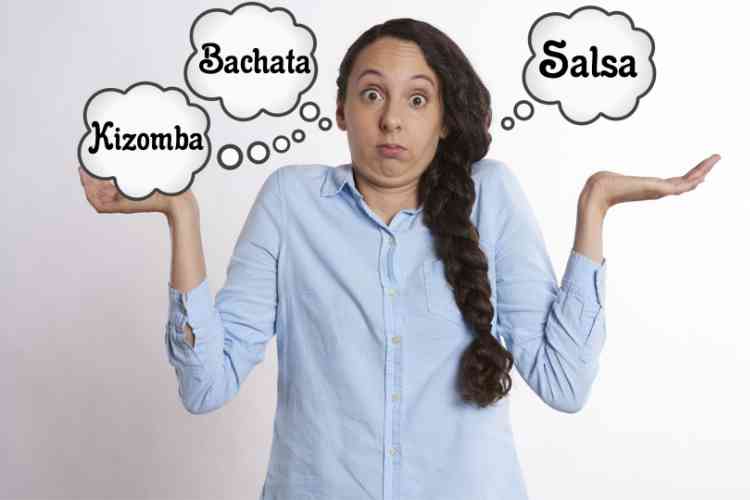
You want to start dancing to meet people, to stay active or for whatever reason. You heard from a colleague that salsa is fun. But an acquaintance said that bachata is also really fun. ‘I think Kizomba suits you better, though,’ says a friend. Now you’re confused: what is the difference between Salsa, Bachata and Kizomba?
That’s what we’re going to explain now
What is Salsa
Salsa is a dance that originates from Cuba and has a lot of influence from African and Spanish culture, music and dance. But to keep it short: watch this video on YouTube
Salsa comes from Cuba and was further developed and made popular in New York.
Characteristics of Salsa dancing
Salsa is characterised by the speed, complexity and explosiveness of its movements. The tempo of the music is often on the fast side (compared to Bachata and Kizomba).
In addition, you cover more distance while dancing. This sounds strange, but it’s true. The steps of salsa are relatively bigger, so you cover more metres (and you can get tired faster if you dance non-stop).
The woman turns a lot more in salsa dancing. This is another factor when you look at which dance is more demanding in terms of stamina. Mainly due to the influence of show dancers, we men tend to turn the women a lot.
Salsa is relatively more complex when you consider the factors above. Lots of turning, high speed and big movements.
What is Bachata
Bachata is a dance that originates from the Dominican Republic. Bachata also has roots in Europe and Africa, but we’re not going to write about that. Watch this video on YouTube
Bachata comes from the Dominican Republic.
Characteristics of Bachata dancing
Bachata is characterised by the footwork and playfulness while dancing. The tempo of the music is average compared to Salsa and Kizomba. Bachata also uses a bar of 8 counts. The difference is that in bachata every count is used for a step or a tap. Whereas Salsa takes 2 counts of rest.
You (normally) dance Bachata relatively small. People make lots of small movements with their feet and therefore cover less distance.
Where Salsa focuses on turning, bachata focuses on being ‘playful’. Depending on the song and the chemistry between the 2 dancers, the playfulness can also turn into flirting. But this is still within the context of dancing.
In general, Bachata is a calmer dance than Salsa. Nowadays there are new styles; Bachata Sensual. Here the movements of the upper body are emphasised more than the footwork.
What is Kizomba
Kizomba can be traced back to Africa, with influence from Angola. Although there are different versions of Kizomba, we will use traditional kizomba for the comparison. Watch this video on YouTube
Kizomba comes from Africa and is usually sung in Portuguese (music)
Characteristics of Kizomba
Kizomba is characterised by its sensual and calm movements. The tempo of the music is usually slower than Salsa and Bachata. In terms of counting, Kizomba is different from Salsa and Bachata. Instead of 8 counts, Kizomba uses 4 counts in a bar.
In this dance, the upper body moves as little as possible and mainly the lower body, in other words the hips, is used.
Compared to Salsa and Bachata, Kizomba is a really flowing dance with the focus on sensual movements.
All 3 side by side
The music
On average Salsa music has a higher tempo, followed by Bachata and then Kizomba. Where Salsa and Bachata music uses lots of instruments, kizomba nowadays is more electronic music.
Salsa and Bachata are almost always sung in Spanish. Whereas Kizomba is often sung in Portuguese.
The dance
Salsa focuses more on turning, explosiveness and moving bigger with all parts of the body.
Bachata is more focused on footwork, smaller playful movements with your partner and also uses all parts of the body
Kizomba is a sensual dance, but with flowing movements. The upper body is only used to lead and follow, while the lower body makes all the graceful movements.
Culture
All 3 dances are performed by a couple of 2 and are meant as social dances.
Salsa and Bachata have most of their history in the Caribbean, while Kizomba has its history in Africa (Angola).
In the Netherlands
All 3 styles are danced in the Netherlands. There’s no point in comparing which one is danced the most. The communities of the 3 dances overlap every week at Salsa, Bachata and Kizomba parties. Dancers can often dance 2 or all 3 styles.
Salsa and Bachata have been popular in the Netherlands a little longer, while Kizomba has only become well known here in the Netherlands in recent years.
So which of the 3 should I dance?
If you’re still not completely sure, we’ll try to give you some final comparisons.
Are you someone who likes moving calmly rather than moving fast?
Bachata or Kizomba
Do you often have loads of energy and do you love lots of (big) movements?
Salsa
Do you get dizzy easily?
Bachata or Kizomba
Do you love lots of turning (spins)?
Salsa
Would you rather dance with your eyes closed on half a square metre?
Kizomba and maybe Bachata too?
Have you been to Cuba and do you love the music and culture?
Salsa
The best advice
What is the difference between Salsa, Bachata and Kizomba. The best advice we can give is to watch all 3 dances at some point and also give them a try. There are many dance schools in the Netherlands where you can do this. For Salsa dancing you can of course come to us, Watapana Dance Company. Want to learn bachata? Then Bachata Passion is a great choice. For Kizomba you can definitely go to Mistura Movement.
Hopefully you now have a picture of what the differences are!
Do you know another difference between Salsa, Bachata and Kizomba? You can help other readers! Write a comment below.